
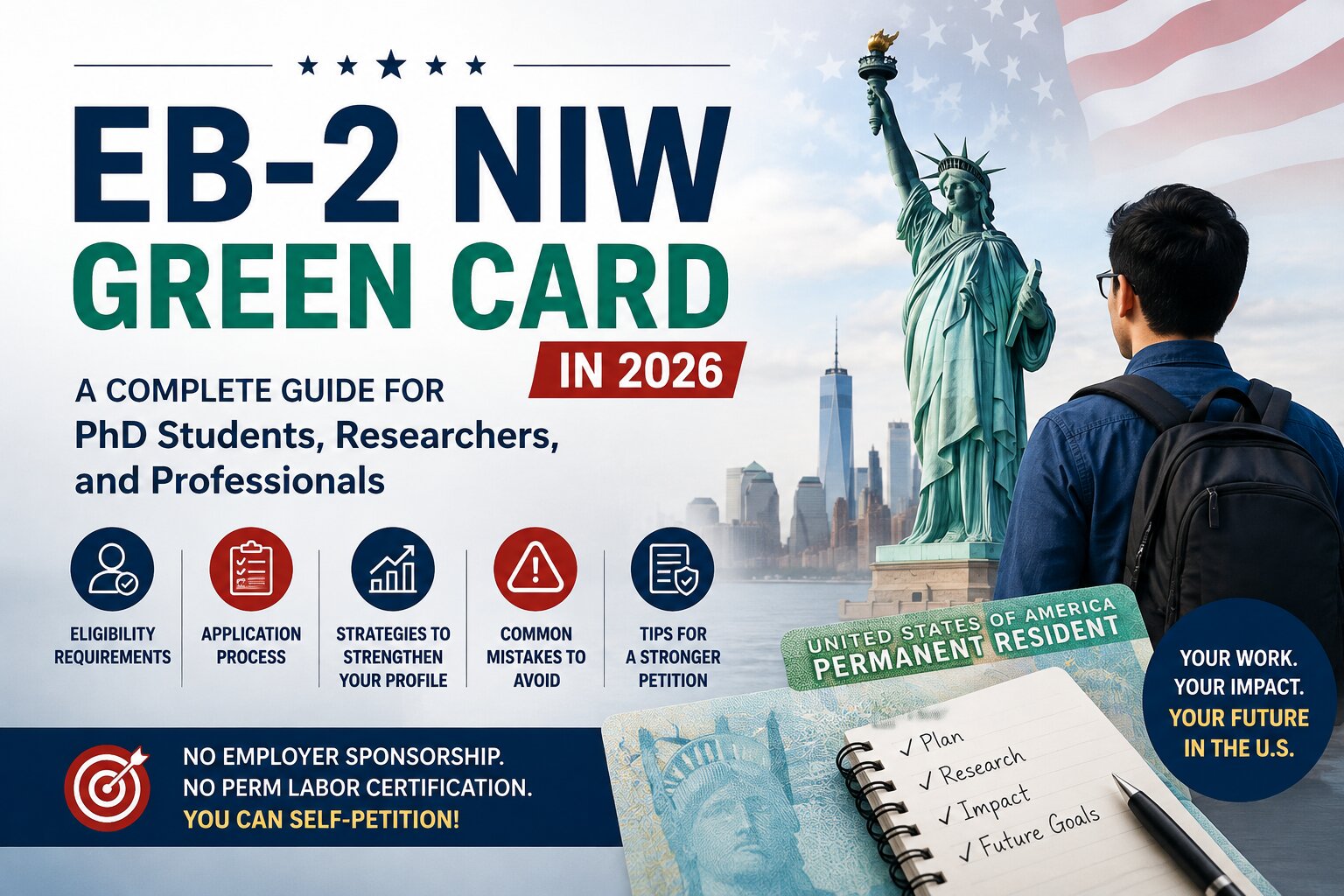
EB-2 NIW Green Card: What You Need to Know Before You Apply
Every year, thousands of highly skilled professionals dream of obtaining permanent residency in the United States. Unfortunately, many delay their preparation because they believe they need hundreds of citations, decades of experience, or a prestigious academic position before they can even consider applying.
The reality is often more nuanced.
The EB-2 National Interest Waiver (NIW) is an employment-based immigration pathway that allows certain qualified individuals to request that the traditional job offer and labor certification requirements be waived because their proposed work has substantial merit and national importance.
Understanding how this pathway works can help you make informed career decisions years before you submit an application.
What Is EB-2 NIW?
The EB-2 National Interest Waiver is part of the employment-based second preference (EB-2) immigrant visa category.
Unlike many employment-based immigration pathways, an approved NIW petition does not require a permanent employer sponsor. Instead, eligible applicants may self-petition if they can demonstrate that waiving the normal job offer and labor certification requirements would benefit the United States.
Each case is evaluated individually based on the evidence submitted.
Who Can Apply?
Many people assume only senior professors or world-famous researchers qualify.
In reality, applicants come from many professional backgrounds, including:
- PhD students
- PhD candidates
- Postdoctoral researchers
- University faculty
- Engineers
- Physicians
- Scientists
- Public health professionals
- Environmental specialists
- AI researchers
- Entrepreneurs
- Industry researchers
- Professionals with advanced degrees
- Individuals who can demonstrate exceptional ability under the EB-2 category
Eligibility depends on the facts and evidence in each individual case.
What Does USCIS Evaluate?
USCIS generally evaluates NIW petitions using the framework established in the Matter of Dhanasar decision.
Broadly speaking, applicants should demonstrate that:
- Their proposed endeavor has substantial merit and national importance.
- They are well positioned to advance that endeavor.
- On balance, it would benefit the United States to waive the normal job offer and labor certification requirements.
These concepts are evaluated using the totality of the evidence submitted.
Do You Need Hundreds of Citations?
No fixed citation number guarantees approval or denial.
Citation counts are only one possible piece of evidence.
Depending on the applicant’s field and circumstances, USCIS may also consider evidence such as:
- Publications
- Research impact
- Patents
- Awards
- Peer review activities
- Conference presentations
- Funding history
- Leadership roles
- Professional memberships
- Media coverage
- Recommendation letters
- Government or industry interest
- Practical implementation of research
- Business or economic impact
Every petition is unique.
Common Myths About EB-2 NIW
Myth 1: I Need 500 Citations
There is no official USCIS citation threshold.
Strong petitions have been approved with different citation profiles depending on the overall evidence.
Myth 2: Only Professors Can Apply
Many successful applicants are early-career researchers or professionals outside academia.
Myth 3: Publications Alone Are Enough
Publications are important, but USCIS evaluates the entire body of evidence rather than a single metric.
Myth 4: Everyone Should File Immediately
Sometimes the strongest strategy is to spend additional time strengthening your profile before filing.
How Can You Strengthen Your Profile?
Preparation often begins long before an immigration petition is filed.
Depending on your profession, helpful activities may include:
- Publishing quality research
- Presenting at conferences
- Building collaborations
- Increasing research visibility
- Participating in peer review
- Developing independent research
- Demonstrating real-world impact
- Building a professional academic website
- Maintaining an updated CV
- Documenting achievements as they occur
Good documentation today can save significant effort later.
Common Mistakes Applicants Make
Many applicants unintentionally weaken their petitions by:
- Waiting until the last minute to organize evidence
- Focusing only on citation numbers
- Ignoring the importance of explaining future work
- Submitting poorly organized exhibits
- Using generic recommendation letters
- Overlooking the importance of a clear petition narrative
- Failing to document professional achievements over time
Organization matters as much as the evidence itself.
Is EB-2 NIW Right for You?
The answer depends on your background, accomplishments, and future professional plans.
Factors that may influence your preparation include:
- Education
- Field of expertise
- Professional achievements
- Research impact
- National importance of your work
- Career trajectory
- Available supporting evidence
There is no single checklist that guarantees approval.
Frequently Asked Questions
Can a PhD student apply for EB-2 NIW?
Some PhD students may qualify depending on their education, evidence, and proposed endeavor. Each petition is evaluated individually.
Do I need an attorney?
Some applicants choose to work with immigration attorneys, while others prepare their own petitions. The appropriate approach depends on the complexity of the case and personal preference.
How long does the process take?
Processing times vary and may change over time depending on USCIS workload, filing choices, and individual circumstances.
Does approval depend only on citations?
No. USCIS evaluates the complete evidence submitted.
Final Thoughts
The EB-2 National Interest Waiver is not simply about collecting publications or increasing citation counts. It is about presenting a well-supported case that demonstrates why your future work is important and why you are well positioned to advance it.
Whether you are still a graduate student, a postdoctoral researcher, or an experienced professional, investing time in building your academic and professional profile early can make a meaningful difference later.
Every immigration case is unique. Before making important legal decisions, review the latest USCIS guidance and consider consulting a qualified immigration attorney if you need legal advice.
Educational Disclaimer
This article is provided for educational and informational purposes only. It does not constitute legal advice, does not create an attorney-client relationship, and should not be relied upon as legal guidance. Immigration laws and policies may change. Always refer to official USCIS resources and seek advice from a qualified immigration attorney regarding your individual circumstances.