

Research Methodology: From Research Idea to Publication
Research Methodology: From Research Idea to Publication is a practical, step-by-step course that guides you through the complete research process. ...
Show more
- Description
- Curriculum
- FAQ
- Notice
- Reviews
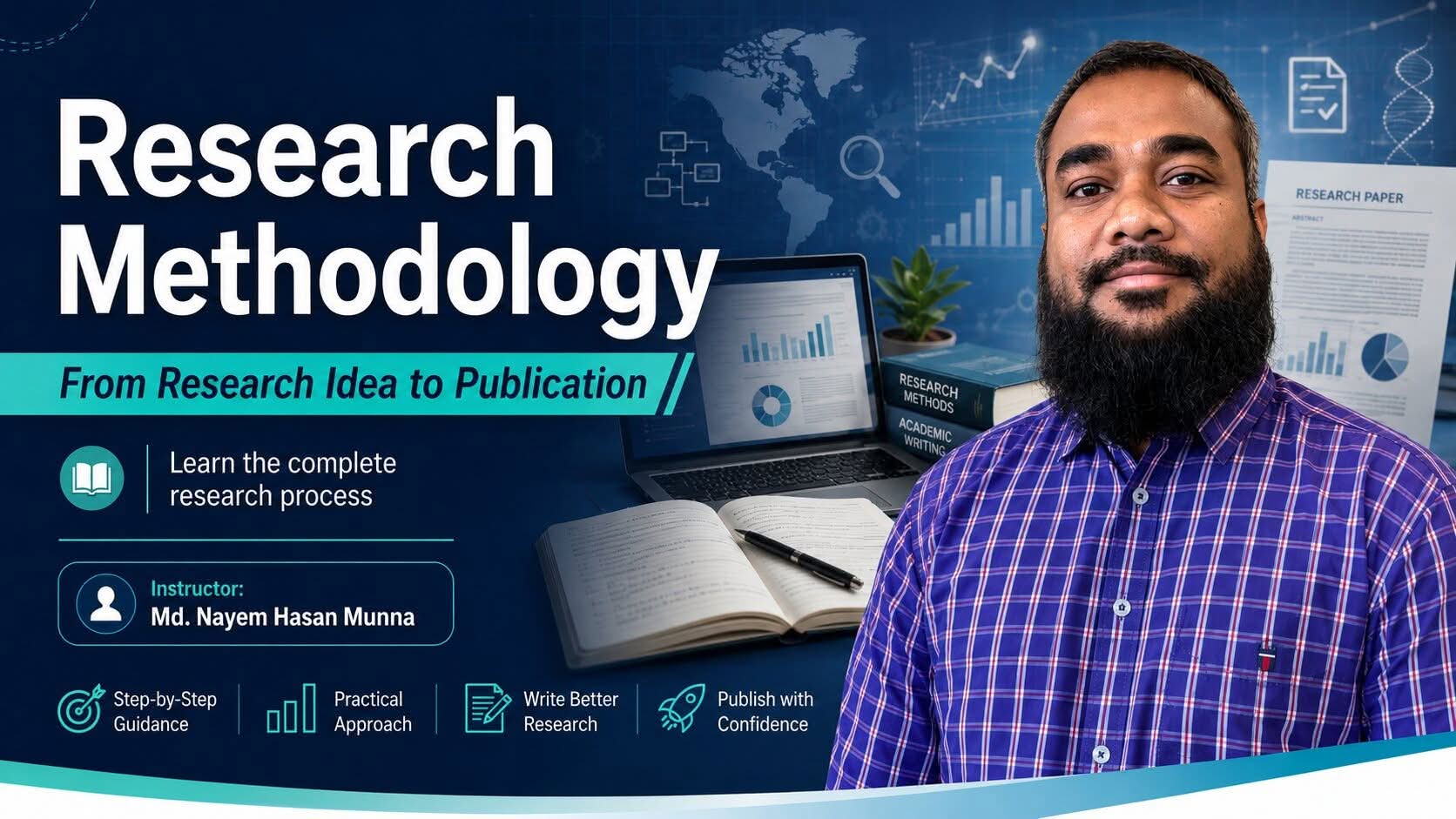
This course provides a complete, step-by-step introduction to the research process, beginning with scientific thinking and research-problem identification and continuing through study design, data collection, analysis, scientific writing, journal submission, peer review, research ethics, and long-term career development.
The course is organized into 5 modules and 20 lessons. Each lesson addresses a specific stage of the research journey and helps learners develop the knowledge and practical skills needed to transform an initial research idea into a scientifically sound study and publication-ready manuscript.
Module 1: Understanding Research and Scientific Thinking
This module introduces the foundations of scientific research. Learners will understand what research means, how scientific knowledge is developed, the major types of research, and how important research problems and knowledge gaps are identified.
Lesson 1: What Is Research?
This lesson introduces the meaning, purpose, and fundamental characteristics of scientific research. Learners will examine how systematic research differs from general information gathering and how research contributes to academia, society, innovation, and evidence-based decision-making.
Topics Covered
- The purpose of scientific research
- Research versus information gathering
- Characteristics of good research
- Why research matters in academia and society
Lesson 2: Scientific Thinking and the Scientific Method
This lesson explains how curiosity, observation, questioning, and evidence contribute to scientific discovery. Learners will explore the scientific method, inductive and deductive reasoning, hypothesis development, and the important distinction between correlation and causation.
Topics Covered
- Curiosity, observation, and hypothesis generation
- Deductive versus inductive reasoning
- The scientific method step by step
- Correlation versus causation
Lesson 3: Types of Research
This lesson introduces the major categories of scientific research and explains when each approach may be appropriate. Learners will compare basic and applied research, experimental and observational studies, and quantitative, qualitative, mixed-methods, and interdisciplinary approaches.
Topics Covered
- Basic versus applied research
- Experimental versus observational research
- Quantitative, qualitative, and mixed methods
- Interdisciplinary research
Lesson 4: Identifying Research Problems
This lesson explains how broad academic interests or real-world challenges can be transformed into focused and researchable problems. Learners will examine research gaps, novelty, significance, feasibility, and the process of developing clear research questions.
Topics Covered
- What makes a research problem important
- Research-gap identification
- Novelty and significance
- Converting problems into research questions
Module 2: Research Planning and Study Design
This module focuses on planning a scientifically valid and feasible study. Learners will develop skills in literature searching, research-question formulation, hypothesis development, experimental design, and sampling.
Lesson 5: Literature Review Strategy
This lesson presents a systematic approach to finding, reading, evaluating, and organizing scientific literature. Learners will explore academic databases, strategic reading techniques, citation searching, and the use of a literature matrix to compare previous studies and identify research gaps.
Topics Covered
- Finding scientific articles efficiently
- Using Google Scholar, Scopus, and Web of Science
- Reading papers strategically
- Building a literature matrix
Lesson 6: Developing Research Questions and Hypotheses
This lesson explains how to develop focused research questions, measurable objectives, and testable hypotheses. Learners will also explore conceptual frameworks and the relationships among research problems, questions, objectives, hypotheses, methods, and expected outcomes.
Topics Covered
- Characteristics of strong research questions
- Hypothesis formulation
- Conceptual frameworks
- Research objectives and expected outcomes
Lesson 7: Experimental Design
This lesson introduces the core principles of designing reliable experiments. Learners will understand the roles of treatments, controls, replication, randomization, and blocking and examine common experimental designs and potential sources of bias.
Topics Covered
- Treatments, controls, and replication
- Randomization and blocking
- Common experimental designs
- Avoiding bias
Lesson 8: Sampling Techniques
This lesson explains how researchers select samples that appropriately represent a target population. Learners will compare probability and non-probability sampling methods and consider sample size, representativeness, statistical power, feasibility, and sampling bias.
Topics Covered
- Population and sample
- Probability sampling
- Non-probability sampling
- Sample-size considerations
Module 3: Data Collection and Data Analysis
This module introduces the methods used to collect, organize, manage, analyze, interpret, and present research data. The emphasis is on selecting appropriate methods and drawing conclusions that are supported by evidence.
Lesson 9: Data Collection Methods
This lesson examines common methods of collecting primary and secondary data. Learners will explore surveys, questionnaires, interviews, focus groups, observations, field experiments, laboratory experiments, and existing data sources.
Topics Covered
- Surveys and questionnaires
- Interviews and focus groups
- Field and laboratory experiments
- Secondary data sources
Lesson 10: Data Management and Research Integrity
This lesson explains how to organize, document, clean, store, and protect research data. Learners will understand the importance of metadata, file-management systems, data dictionaries, quality control, reproducibility, confidentiality, and transparent documentation.
Topics Covered
- Data organization
- Metadata and documentation
- Data cleaning
- Reproducible research practices
Lesson 11: Statistical Thinking for Researchers
This lesson introduces the statistical reasoning needed to understand research results. Learners will examine descriptive and inferential statistics, hypothesis testing, confidence intervals, statistical significance, uncertainty, and frequent statistical mistakes.
Topics Covered
- Descriptive statistics
- Inferential statistics
- Hypothesis testing
- Common statistical mistakes
Lesson 12: Data Analysis and Interpretation
This lesson explains how raw data are transformed into meaningful research findings. Learners will explore analytical decision-making, graphical and tabular presentation, statistical and practical significance, effect size, uncertainty, and responsible interpretation.
Topics Covered
- Turning data into findings
- Graphs, tables, and visualization
- Understanding significance and effect size
- Avoiding overinterpretation
Module 4: Writing and Publishing Research
This module guides learners through the preparation of a scientific manuscript and the academic publishing process. It covers manuscript structure, scientific writing, journal selection, submission, revision, and peer review.
Lesson 13: How to Structure a Research Paper
This lesson explains how to organize a scientific manuscript using the AIMRaD framework. Learners will examine the purpose and content of the title, abstract, introduction, methods, results, discussion, conclusion, references, tables, and figures.
Topics Covered
- The AIMRaD framework
- Title and abstract writing
- Introduction and literature review
- Methods, results, and discussion
Lesson 14: Scientific Writing Techniques
This lesson focuses on writing scientific content clearly, concisely, and logically. Learners will explore paragraph development, transitions, terminology, scientific storytelling, editing, grammar, consistency, and writing for international and high-impact journals.
Topics Covered
- Writing clearly and concisely
- Storytelling in scientific writing
- Common grammar and style mistakes
- Writing for high-impact journals
Lesson 15: Publication Strategy
This lesson explains how to select an appropriate and credible journal and prepare a manuscript for submission. Learners will examine journal scope, readership, metrics, open-access options, publication fees, predatory journals, cover letters, declarations, and submission requirements.
Topics Covered
- Selecting the right journal
- Understanding journal metrics
- Submission preparation
- Cover letters and ethical declarations
Lesson 16: Peer Review and Publication Success
This lesson describes how editors and reviewers evaluate manuscripts and how researchers should respond to editorial decisions. Learners will practice interpreting reviewer comments, preparing point-by-point responses, revising effectively, and avoiding common reasons for desk rejection.
Topics Covered
- What reviewers look for
- Responding to reviewers
- Revising manuscripts effectively
- Avoiding desk rejection
Module 5: Research Ethics and Academic Integrity
This module examines the ethical responsibilities of researchers throughout the research and publication process. It also addresses academic misconduct, responsible use of artificial intelligence, professional development, collaboration, and long-term research success.
Lesson 17: Principles of Research Ethics
This lesson introduces the principles of responsible research conduct. Learners will examine ethical approval, informed consent, confidentiality, human and animal research ethics, risk management, conflicts of interest, and accurate reporting.
Topics Covered
- Responsible conduct of research
- Human and animal research ethics
- Informed consent
- Confidentiality, accountability, and ethical reporting
Lesson 18: Plagiarism and Academic Misconduct
This lesson explains plagiarism and other serious forms of academic misconduct. Learners will examine direct plagiarism, improper paraphrasing, self-plagiarism, duplicate publication, data fabrication, data falsification, image manipulation, and unethical authorship practices.
Topics Covered
- Types of plagiarism
- Self-plagiarism
- Data fabrication and falsification
- Ethical authorship practices
Lesson 19: AI Tools in Research
This lesson explores how artificial intelligence can be used responsibly to support research. Learners will examine AI-assisted brainstorming, literature organization, writing improvement, coding, and data analysis while considering accuracy, confidentiality, disclosure, bias, fabricated references, and overreliance.
Topics Covered
- Ethical use of AI
- Literature-review assistance
- AI for writing and analysis
- Limitations and risks
Lesson 20: Becoming a Successful Researcher
This lesson focuses on the long-term development of a productive, ethical, and resilient researcher. Learners will explore research-portfolio development, academic networking, collaboration, productivity systems, professional visibility, goal setting, and academic career planning.
Topics Covered
- Building a research portfolio
- Networking and collaboration
- Research productivity systems
- Long-term academic career planning
1. Do I need previous research experience to take this course?
No. The course starts with fundamental research concepts and gradually progresses to study design, data analysis, scientific writing, publication, and research ethics. It is suitable for beginners and learners with some research experience.
2. Will this course help me write and publish a research paper?
Yes. The course explains how to develop a research idea, design a study, analyze and interpret data, structure a scientific paper, select a suitable journal, prepare a submission, and respond to reviewers. However, completing the course does not guarantee publication.
3. Is this course suitable for students from all academic disciplines?
Yes. The course is useful for learners from science, agriculture, environment, engineering, health sciences, social sciences, education, business, and other research-based fields. The main research principles can be applied across disciplines.
This course is provided for educational and professional-development purposes only. It does not guarantee thesis approval, journal acceptance, publication, academic employment, research funding, or any specific outcome.
Learners are responsible for conducting their own research, verifying all information, following institutional and journal guidelines, and maintaining academic integrity. The course does not provide ghostwriting, fabricated data, completed assignments, or guaranteed publication services.
Research policies, ethical requirements, journal standards, and rules regarding the use of AI may vary by institution, discipline, and publisher. Always follow the requirements of your university, supervisor, ethics committee, funding organization, and target journal.
Please, login to leave a review
Course details
Level
Intermediate
Yes
Lifetime
Any Device
Basic info
Basic Course Information
Course Title: Research Methodology: From Research Idea to Publication
Course Category: Research Methodology, Scientific Writing, and Academic Publishing
Course Level: Beginner to Intermediate
Number of Modules: 5
Number of Lessons: 20
Learning Format: Online, self-paced learning
Language: English
Course Access: Available through the Earth Review learning platform
Primary Focus: Guiding learners through the complete research process, from developing a research idea to preparing and submitting a scientific manuscript.
Topics Covered:
- Scientific thinking and research fundamentals
- Research problem and gap identification
- Literature review
- Research questions and hypotheses
- Experimental design and sampling
- Data collection and management
- Statistical thinking and interpretation
- Scientific writing
- Journal selection and manuscript submission
- Peer review and revision
- Research ethics and academic integrity
- Responsible use of AI in research
- Research career and portfolio development
Suitable Disciplines: The course is applicable to learners from science, agriculture, environmental studies, engineering, health sciences, social sciences, education, business, geography, natural resources, and other research-based fields.
Assessment Format: Knowledge checks, practical exercises, reflection activities, and research-planning tasks are included throughout the course.
Certificate: A certificate of completion will be awarded to learners who complete the required lessons and course activities.
Provided By: Earth Review, a specialized education and consultation brand operated by Nayem Digital LLC.
Course requirements
Intended audience
Present. Publish. Impact.
Submit Your Conceptual Article

Academic Profile Evaluation
Collaborate with me.
READ THE PAPERS