Research Ethics and Academic Integrity
Research Ethics and Academic Integrity is a practical course designed to help students, researchers, and academic professionals conduct and publish ...
Show more

Instructor
Md. Nayem Hasan Munna
- Description
- Curriculum
- FAQ
- Notice
- Reviews
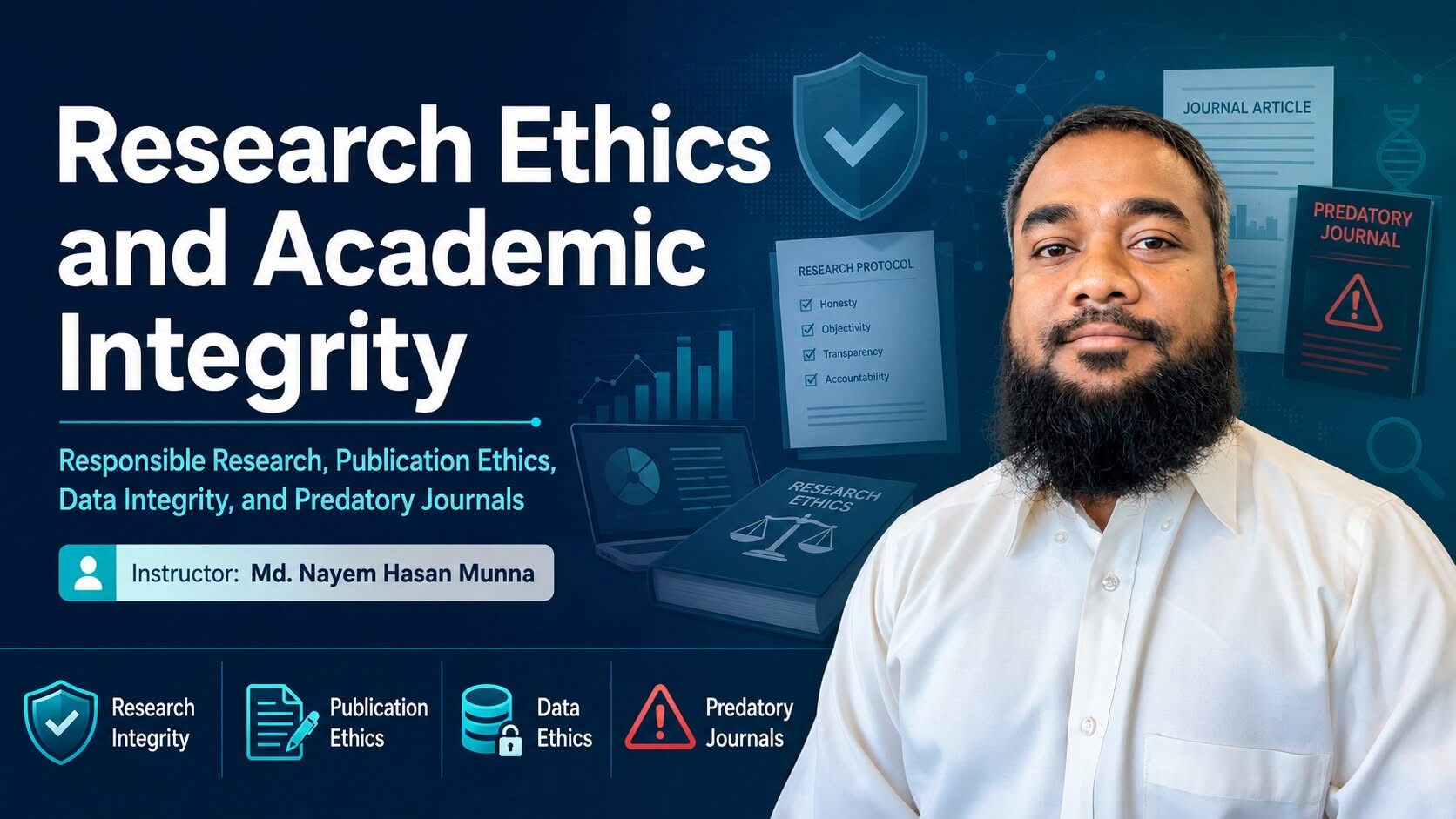
Research Ethics and Academic Integrity is a structured course designed to help students, researchers, academics, and professionals understand the ethical responsibilities involved in conducting, managing, writing, and publishing research.
The course covers responsible research conduct, ethical decision-making, authorship, conflicts of interest, plagiarism, data integrity, reproducibility, open science, predatory journals, retractions, and academic misconduct. It also explains how unethical practices can affect individual researchers, institutions, scientific knowledge, and public trust.
Through four modules and fifteen lectures, learners will develop the ability to recognize ethical concerns, make responsible decisions, protect the reliability of their research, and maintain a credible academic reputation.
Module 1: Responsible Conduct of Research
This module introduces the foundations of ethical research practice. Learners will examine the meaning of research integrity, the responsibilities of researchers, and practical approaches to making ethical decisions throughout the research process.
Lecture 1: Understanding Research Integrity
This lecture introduces the principles that support trustworthy and responsible research.
Topics Covered
- Meaning of research integrity
- Honesty, accuracy, transparency, and accountability
- Reliability of scientific evidence
- Trust between researchers, institutions, and society
- Consequences of poor research practices
- Institutional and professional expectations
Lecture 2: Ethical Decision-Making in Research
This lecture explains how researchers can recognize ethical problems and make responsible decisions when facing uncertainty or competing interests.
Topics Covered
- Identifying ethical concerns
- Evaluating risks and potential harm
- Recognizing affected individuals and communities
- Considering institutional and professional standards
- Documenting ethical decisions
- Seeking advice from supervisors, ethics committees, or institutions
- Managing difficult or uncertain research situations
Lecture 3: Scientific Responsibility and Researcher Accountability
This lecture examines the responsibilities researchers have throughout the planning, conduct, reporting, and communication of research.
Topics Covered
- Responsibilities of principal investigators and research teams
- Research supervision and mentoring
- Accurate documentation and reporting
- Responsible communication of findings
- Correcting errors in research
- Accountability to participants, funders, institutions, and society
- Creating an ethical research environment
Module 2: Publication Ethics
This module focuses on ethical responsibilities during manuscript preparation, authorship determination, submission, peer review, and publication.
Lecture 4: Ethical Authorship and Contributor Responsibilities
This lecture explains how authorship should be determined and why inappropriate authorship practices can damage trust and accountability.
Topics Covered
- General authorship criteria
- Intellectual and practical contributions
- Author responsibilities
- Author order and contribution statements
- Corresponding author responsibilities
- Gift, guest, honorary, and ghost authorship
- Acknowledging non-author contributions
- Resolving authorship disagreements
Lecture 5: Duplicate and Redundant Publication
This lecture examines the ethical problems associated with publishing the same or substantially similar work more than once.
Topics Covered
- Duplicate publication
- Redundant publication
- Overlapping manuscripts
- Salami slicing
- Reusing previously published results
- Secondary publication
- Disclosure of related manuscripts
- Consequences of duplicate publication
Lecture 6: Self-Plagiarism and Responsible Text Reuse
This lecture explains self-plagiarism and how researchers can responsibly reuse ideas, methods, or text from their previous work.
Topics Covered
- Meaning of self-plagiarism
- Text recycling
- Reusing methods descriptions
- Reusing tables, figures, and data
- Citation of previous work
- Copyright and publisher permissions
- Thesis-to-article publication
- Avoiding misleading claims of originality
Lecture 7: Conflicts of Interest and Publication Transparency
This lecture explains how financial, professional, institutional, or personal interests may influence research and publication.
Topics Covered
- Financial conflicts of interest
- Personal and professional relationships
- Institutional interests
- Funding-source disclosure
- Reviewer and editor conflicts
- Managing potential bias
- Conflict-of-interest statements
- Transparency in research publication
Module 3: Data Ethics
This module covers the ethical collection, organization, storage, analysis, sharing, and preservation of research data.
Lecture 8: Ethical Data Management
This lecture introduces responsible practices for managing research data throughout the research lifecycle.
Topics Covered
- Data-management planning
- Accurate data recording
- File organization and naming
- Metadata and documentation
- Data storage and backup
- Privacy, confidentiality, and security
- Data ownership and access
- Long-term preservation
- Data-sharing responsibilities
Lecture 9: Data Fabrication and Falsification
This lecture explains two of the most serious forms of research misconduct and how they undermine scientific knowledge.
Topics Covered
- Definition of data fabrication
- Definition of data falsification
- Inventing observations or participants
- Manipulating measurements or results
- Improper removal of data
- Misleading image manipulation
- Selective reporting
- Consequences for researchers and institutions
- Preventing and reporting misconduct
Lecture 10: Reproducibility and Transparent Research
This lecture examines why research methods and analytical processes should be documented clearly enough for others to understand, evaluate, and potentially repeat the work.
Topics Covered
- Reproducibility and replicability
- Transparent methods reporting
- Data dictionaries and metadata
- Analytical documentation
- Code and software versioning
- Reporting exclusions and analytical decisions
- Pre-registration and registered reports
- Limitations to reproducibility
Lecture 11: Open Science and Responsible Data Sharing
This lecture introduces open-science practices and the ethical considerations involved in sharing research outputs.
Topics Covered
- Principles of open science
- Open-access publishing
- Data repositories
- Sharing code, protocols, and materials
- FAIR data principles
- Participant privacy and confidential information
- Intellectual property concerns
- Embargoes and controlled access
- Responsible reuse and citation of shared data
Module 4: Predatory Journals and Academic Misconduct
This module helps learners recognize deceptive publishing practices, understand retractions and corrections, and protect their academic reputation.
Lecture 12: How Predatory Journals Operate
This lecture explains the business practices commonly associated with deceptive or unethical publishers.
Topics Covered
- Meaning of predatory publishing
- Misleading journal invitations
- Aggressive email solicitation
- False editorial boards
- Fake or unclear peer review
- Hidden publication fees
- Misleading claims about indexing and impact
- Extremely rapid acceptance
- Differences between legitimate open access and predatory publishing
Lecture 13: Recognizing Unethical Publishers and Conferences
This lecture provides practical strategies for evaluating journals, publishers, and academic conferences before submission or payment.
Topics Covered
- Evaluating journal aims and scope
- Checking editorial-board information
- Verifying indexing claims
- Reviewing peer-review policies
- Evaluating publication fees
- Examining previously published articles
- Checking contact information and publisher transparency
- Recognizing cloned or hijacked journals
- Identifying questionable conferences
- Using journal-evaluation checklists
Lecture 14: Retractions, Corrections, and Expressions of Concern
This lecture explains how the scholarly record is corrected when published research contains serious errors or misconduct.
Topics Covered
- Purpose of corrections
- Corrigenda and errata
- Expressions of concern
- Article retractions
- Retraction notices
- Honest error versus misconduct
- Responsibilities of authors, editors, and institutions
- Effects of retractions on the scientific record
- Responding professionally to discovered errors
Lecture 15: Protecting Your Academic Reputation
This lecture provides practical guidance for maintaining professional credibility and responding responsibly to ethical concerns.
Topics Covered
- Developing ethical research habits
- Maintaining accurate research records
- Selecting trustworthy collaborators
- Communicating authorship expectations early
- Evaluating journals before submission
- Avoiding misleading academic services
- Protecting accounts, data, and documents
- Responding to allegations or disputes
- Correcting mistakes transparently
- Building a long-term reputation for integrity
_________
Complete Module and Lecture List
Module 1: Responsible Conduct of Research
- Understanding Research Integrity
- Ethical Decision-Making in Research
- Scientific Responsibility and Researcher Accountability
Module 2: Publication Ethics
- Ethical Authorship and Contributor Responsibilities
- Duplicate and Redundant Publication
- Self-Plagiarism and Responsible Text Reuse
- Conflicts of Interest and Publication Transparency
Module 3: Data Ethics
- Ethical Data Management
- Data Fabrication and Falsification
- Reproducibility and Transparent Research
- Open Science and Responsible Data Sharing
Module 4: Predatory Journals and Academic Misconduct
- How Predatory Journals Operate
- Recognizing Unethical Publishers and Conferences
- Retractions, Corrections, and Expressions of Concern
- Protecting Your Academic Reputation
1. Do I need previous research or publication experience to take this course?
No. The course begins with foundational concepts and is suitable for beginners. It is also useful for experienced researchers who want to strengthen their understanding of research ethics, publication standards, and academic integrity.
2. Will this course help me identify predatory journals and unethical publishers?
Yes. The course explains how predatory journals operate, common warning signs, misleading indexing and impact claims, unethical publication practices, and practical steps for evaluating a journal before submission.
3. Does this course provide legal or institutional advice on research misconduct cases?
No. The course provides general educational guidance on ethical research and publication practices. For specific allegations, disputes, investigations, or institutional procedures, learners should consult their university, research-integrity office, ethics committee, journal editor, or an appropriately qualified professional.
This course is provided for educational and professional-development purposes only. It does not replace institutional policies, research-ethics training, legal advice, or formal guidance from a university, journal, ethics committee, or research-integrity office.
Learners are responsible for following the rules of their institution, funding agency, professional organization, and target journal. Ethical requirements may vary depending on the discipline, country, research method, and type of participants or data involved.
The course does not support plagiarism, ghostwriting, fabricated or falsified data, duplicate publication, misleading authorship, predatory publishing, or any other form of academic misconduct. Completing the course does not guarantee journal acceptance, institutional approval, certification, employment, funding, or resolution of a misconduct case.
Please, login to leave a review
Course details
Level
Intermediate
Yes
Lifetime
Any Device
Basic info
Course Title: Research Ethics and Academic Integrity
Course Category: Research Ethics, Publication Ethics, and Academic Integrity
Course Level: Beginner to Intermediate
Number of Modules: 4
Number of Lectures: 15
Learning Format: Online, self-paced learning
Language: English
Primary Focus: Helping learners understand ethical research conduct, responsible publication, data integrity, academic misconduct, predatory publishing, and protection of professional reputation.
Main Topics Covered:
- Research integrity
- Ethical decision-making
- Scientific responsibility
- Authorship and contributor roles
- Duplicate and redundant publication
- Self-plagiarism
- Conflicts of interest
- Ethical data management
- Data fabrication and falsification
- Reproducibility and transparency
- Open science and responsible data sharing
- Predatory journals and conferences
- Retractions and corrections
- Academic misconduct
- Protecting academic reputation
Suitable Disciplines: The course is applicable to students, researchers, faculty members, and professionals from science, agriculture, environment, engineering, health sciences, social sciences, education, business, and other research-based disciplines.
Assessment Format: Knowledge checks, ethical case studies, reflection activities, and practical journal-evaluation exercises will be included.
Certificate: A certificate of completion will be awarded to learners who complete the required lectures and course activities.
Provided By: Earth Review, a specialized education and consultation brand operated by Nayem Digital LLC.
Course requirements
No previous training in research ethics is required. This course begins with foundational principles and gradually introduces publication ethics, data integrity, academic misconduct, predatory publishing, and professional responsibility.
Learners should have:
- Basic academic reading and writing skills
- An interest in research, thesis preparation, scientific publication, or higher education
- Access to a computer, tablet, or smartphone
- A education
- Access to a computer, tablet, or smartphone
- A stable internet connection
- Basic familiarity with academic articles and research documents
- Willingness to examine ethical case studies and reflect on responsible research practices
- Commitment to honesty, transparency, accountability, and academic integrity
Previous research or publication experience may be helpful, but it is not required. The course is suitable for beginners as well as experienced learners who want to strengthen their understanding of ethical research and publishing practices.
Intended audience
This course is designed for students, researchers, academics, and professionals who want to understand and apply ethical standards throughout the research and publication process.
It is suitable for:
- Bachelor’s, master’s, and PhD students
- Thesis and dissertation researchers
- Research assistants and early-career researchers
- University faculty members and academic supervisors
- Authors preparing journal manuscripts
- Journal reviewers and editorial-board members
- Professionals involved in scientific, institutional, or applied research
- Researchers managing, analyzing, or sharing data
- Individuals concerned about plagiarism, authorship, conflicts of interest, or publication ethics
- Researchers who want to recognize predatory journals and unethical publishers
- Learners seeking to protect their academic credibility and professional reputation
- Individuals from science, agriculture, environment, engineering, health, social science, education, business, and other research-based disciplines
No previous training in research ethics is required. The course is suitable for beginners as well as experienced researchers who want to strengthen their understanding of responsible research, data integrity, publication ethics, and academic misconduct.


Present. Publish. Impact.

Submit Your Conceptual Article
Academic Profile Evaluation

Collaborate with me.

READ THE PAPERS