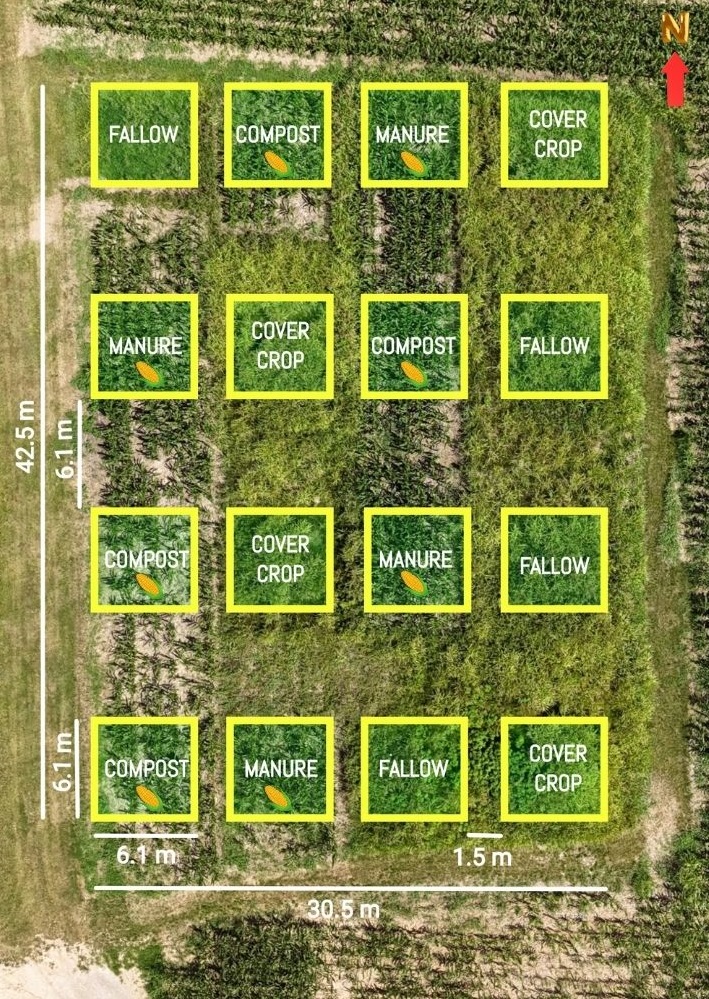
The overarching goal of this PhD research is to evaluate how long-term no-tillage management combined with organic amendments and cover cropping improves soil physical quality, water regulation, and carbon–nitrogen sequestration in temperate agroecosystems, and to develop integrative, science-based indicators that support climate-resilient and sustainable agricultural management.
More specifically, the thesis aims to:
- Quantify the long-term effects of compost, manure, cover crops, and fallow management on soil physical properties, including bulk density, porosity, aggregate stability, penetration resistance, and saturated hydraulic conductivity.
- Develop and apply a robust Soil Physical Quality Index (SPQi) to integrate multiple soil indicators into a single, quantitative framework for evaluating soil health under long-term management systems.
- Assess how organic amendments influence plant-available water capacity (PAWC) and pore-size distribution, thereby enhancing soil hydrological resilience and drought buffering capacity.
- Examine the relationships between soil physical quality, soil organic carbon (SOC), and total nitrogen (TN) stocks (Munna and Lal, 2026) to understand how structural improvements support carbon and nitrogen sequestration.
- Provide practical recommendations for farmers, land managers, and policymakers to promote climate-smart, soil-conserving, and water-efficient agricultural practices based on long-term experimental evidence.
This goal directly aligns with your abstract, which emphasizes improving soil structure, water availability, and carbon storage under long-term no-till systems with organic amendments, while contributing to food security and climate resilience.